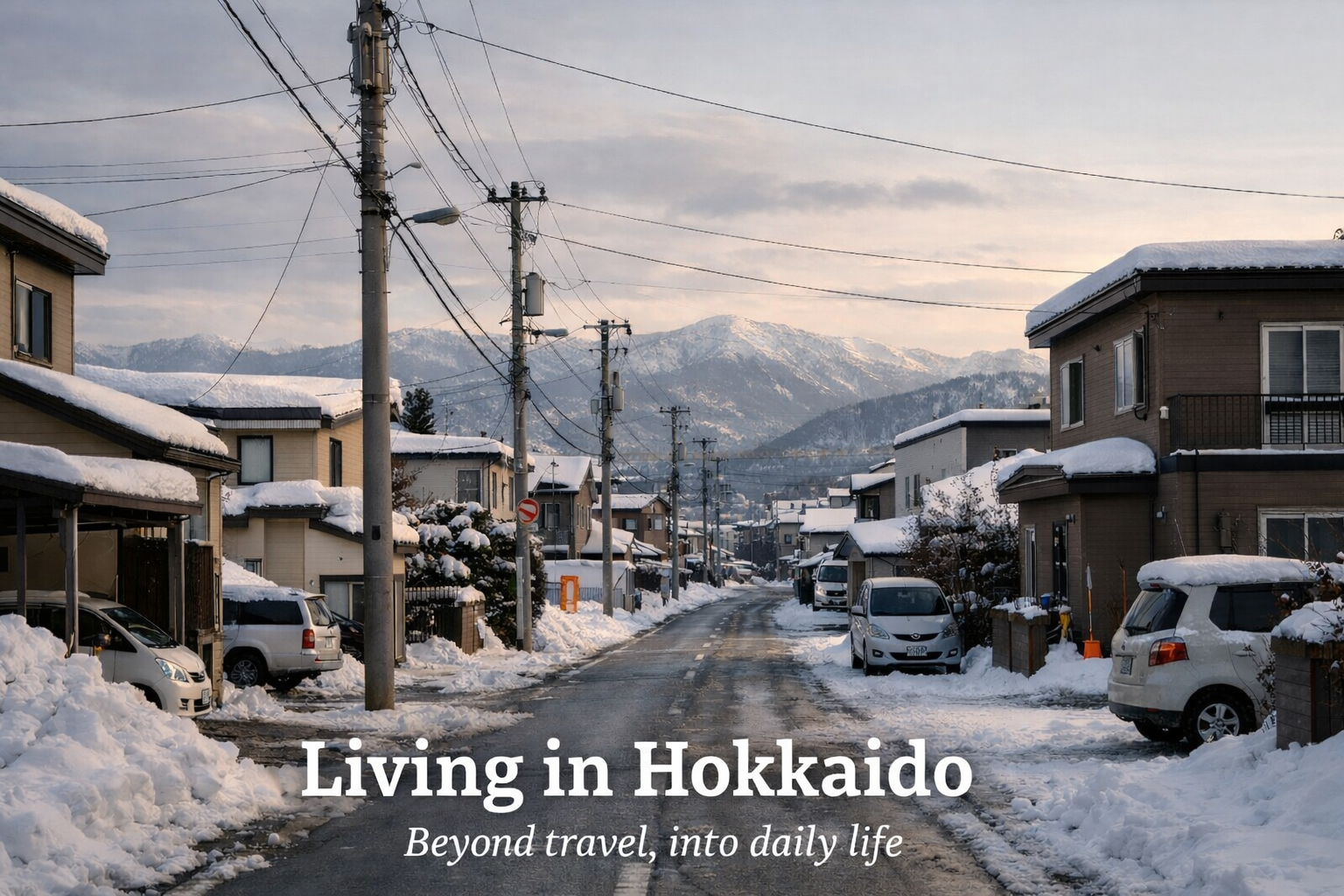
What It’s Really Like Living in Hokkaido
The Reality Beyond Travel Photos
When people hear the word Hokkaido, many imagine wide open landscapes, deep snow,
fresh seafood, and hot springs surrounded by silence.
That image isn’t wrong. But it is incomplete.
Living in Hokkaido is very different from visiting it as a traveler. This article is not a travel guide, and it’s not written to persuade anyone to move here.
It is an honest description of what daily life in Hokkaido actually feels like, based on long-term experience — including the quiet moments, the difficulties, and the parts that rarely appear in travel blogs.
This article is based on real daily experience living in Hokkaido, not short-term travel.
- Why People Are Drawn to the Idea of Living in Hokkaido
- Hokkaido Is in Japan, but Daily Life Works Differently
- Daily Life in Hokkaido Is Quiet — Really Quiet
- Winter in Hokkaido Is Beautiful — and Demanding
- Summer in Hokkaido: A Quiet Advantage
- Safety and Preparedness Are Built into Daily Life
- The Cost of Living: Lower, but Different
- What Tourists Rarely Notice
- Who Is Living in Hokkaido Right For?
- Living in Hokkaido Is a Lifestyle Choice
Why People Are Drawn to the Idea of Living in Hokkaido
Most people who feel attracted to Hokkaido are not only interested in the place itself.
They are often reacting to their current life.
Large cities are convenient. Everything is close. Information, noise, and people are always around.
At the same time, city life quietly demands constant attention:
- Crowds
- Background noise
- Endless stimulation
- Mental fatigue that builds without being noticed
Hokkaido represents distance from that pressure.
Less noise. More space. A slower rhythm.
That image is partly true — and partly idealized.
Hokkaido Is in Japan, but Daily Life Works Differently
Hokkaido is part of Japan, but daily life here operates on different assumptions.
Distance is the first difference.
On a map, towns appear close together. In reality, driving 30 or 40 minutes for basic errands is normal.
In many areas, public transportation simply does not exist.
The second difference is seasonal impact.
In Hokkaido, weather is not casual conversation. It is a decision-making factor.
Snowfall changes:
- When you leave home
- How you shop
- Whether you go out at all
Plans are flexible by necessity. This adjustment takes time for newcomers.
Daily Life in Hokkaido Is Quiet — Really Quiet
One of the most surprising aspects of living in Hokkaido is how quiet everyday life is.
After the morning commute, streets quickly calm down. Residential areas often remain silent for hours.
At night:
- Shops close early
- Streets are dark
- Background noise disappears
At first, this silence can feel uncomfortable — even unsettling.
Many people describe a sense of boredom or isolation in the beginning.
Then, something changes.
Over time, residents realize that this quiet reduces mental exhaustion.
There are fewer small irritations. Less sensory overload. More space to think.
Winter in Hokkaido Is Beautiful — and Demanding
To be honest, winter in Hokkaido is not easy.
Snow accumulates daily. Temperatures stay low. Daylight hours are short.
Simple activities require effort:
- Clearing snow before leaving home
- Warming the car before driving
- Walking carefully on icy roads
There is nothing romantic about these routines.
What makes winter manageable is attitude.
In Hokkaido, winter is not treated as an inconvenience to escape. It is treated as a given.
Homes prioritize insulation over design. Heating systems are powerful. Winter tires are standard equipment.
Plans change according to conditions.
People do not fight winter. They adapt to it.
Winter life in Hokkaido is very different from what tourists expect.
Read: Winter Life in Hokkaido: What Tourists Don’t Expect
Summer in Hokkaido: A Quiet Advantage
While winter defines Hokkaido’s image, summer defines its livability.
Humidity is low. Mornings and evenings are cool. Many nights require no air conditioning.
Compared to most of Japan, summer in Hokkaido feels gentle.
Visitors often focus on winter scenery, but residents know that summer is when daily life feels easiest.
This contrast is rarely explained in travel content.
Safety and Preparedness Are Built into Daily Life
Living in Hokkaido means living alongside natural risks.
Earthquakes occur. Snowstorms reduce visibility. Extreme cold is possible.
Because of this, preparedness is normal — not dramatic.
People:
- Keep emergency supplies
- Monitor weather closely
- Avoid unnecessary risks
These actions are not driven by fear. They are based on realism and experience.
Safety in Hokkaido comes from understanding limits, not ignoring them.
Safety is one of the most common concerns about living in Hokkaido.
Read: Is Hokkaido Safe? Earthquakes, Snow & Daily Life
The Cost of Living: Lower, but Different
Compared to Tokyo, housing costs are lower. Food quality is high for the price.
However, Hokkaido has hidden expenses:
- Heating costs in winter
- Vehicle ownership in rural areas
- Seasonal equipment
Hokkaido is not “cheap.” It is a place where money is spent differently.
Understanding this difference prevents disappointment.
Costs depend heavily on season and lifestyle.
Read: Cost of Living in Hokkaido (Rent, Food, Transport)
What Tourists Rarely Notice
Short-term visitors often miss important aspects of daily life:
- How quiet neighborhoods are
- How strictly snow-related rules are followed
- How homes prioritize function over appearance
- How normal winter driving becomes
Hokkaido values practicality over convenience or aesthetics.
Who Is Living in Hokkaido Right For?
Life in Hokkaido suits people who:
- Appreciate quiet environments
- Can adapt to seasonal change
- Prefer stability over constant excitement
It can feel limiting for those who rely heavily on convenience, nightlife, or constant stimulation.
This is not about better or worse — only compatibility.
Living in Hokkaido Is a Lifestyle Choice
Living in Hokkaido is not just choosing a place.
It is choosing:
- Slower pace
- Fewer options
- Greater awareness of nature
- Stronger emphasis on safety and preparation
For people who value these things, Hokkaido feels deeply comfortable.
This article marks the starting point of LivingInHokkaido.com.
Future articles will explore winter life, safety, costs, housing, and transportation — topics that travel guides rarely explain honestly.
No exaggeration. No promotion. Just daily reality.
Want to know who runs this site?
About LivingInHokkaido

コメント