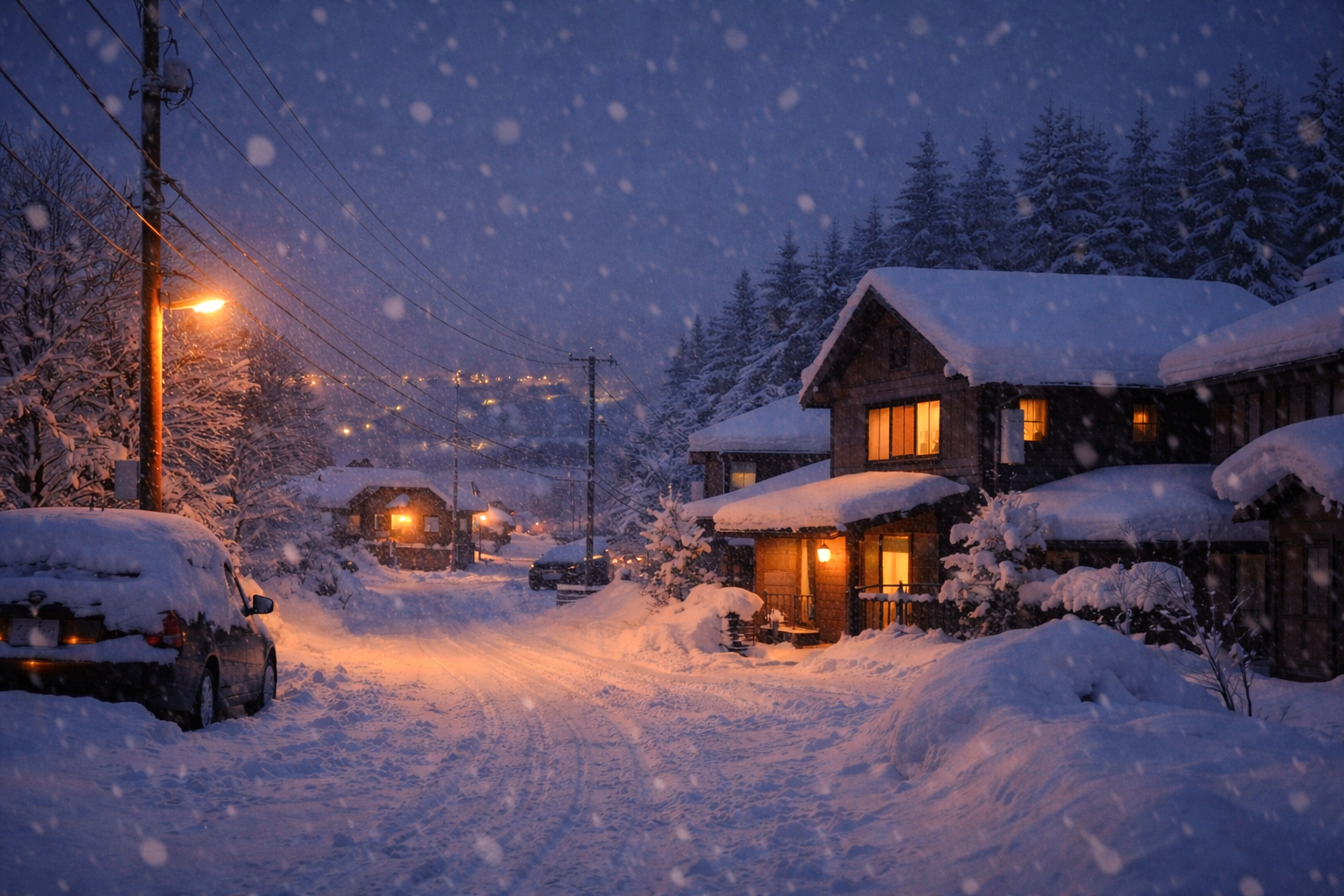
When people research winter in Hokkaido, they quickly find familiar words.
Cold.
Snowy.
Harsh.
Beautiful.
None of those are wrong.
But they don’t explain what it feels like to actually live through a Hokkaido winter.
So this article won’t explain winter.
It will show one ordinary winter day — as it really happens.
- Morning: The Moment That Decides the Whole Day
- Morning (Again): No One Thinks They Are “Fighting” the Snow
- Late Morning: Getting There Safely Matters More Than Getting There Fast
- Midday: Life Continues, Even When Everything Is White
- Evening: When Sound Disappears
- Night: Choosing Not to Go Out
- The Hardest Part of Winter Isn’t the Cold
- An Honest Conclusion
Morning: The Moment That Decides the Whole Day
In winter, the day doesn’t start with checking your phone.
It starts with opening the curtain.
Outside, the road that existed yesterday is gone.
Everything is white.
Quiet.
Different.
And immediately, a thought forms:
“Alright. Today’s plans are going to change.”
In Hokkaido, this isn’t frustration.
It’s just information.
Morning (Again): No One Thinks They Are “Fighting” the Snow
Before leaving, there is snow to deal with.
The entrance.
The walkway.
The car.
You grab a shovel and move snow from one place to another.
What’s important is this:
No one thinks they are battling nature.
Snow is something you clear — like brushing your teeth.
Not enjoyable.
Not dramatic.
Just necessary.
Late Morning: Getting There Safely Matters More Than Getting There Fast
Once you’re driving, your sense of speed changes.
Braking starts earlier.
Turns are slower.
Distance between cars increases.
In winter Hokkaido, the rule is simple:
Being late is acceptable.
Having an accident is not.
According to data published by the
Japan Meteorological Agency
,
snowfall intensity and road surface conditions can change significantly within hours during midwinter.
No one rushes you.
And the people who do rush usually regret it.
Time is flexible.
Safety isn’t.
Midday: Life Continues, Even When Everything Is White
Here’s something many people don’t expect.
Even when the world outside looks extreme, life continues normally.
Shops are open.
People are working.
Daily routines don’t stop.
Snow becomes background noise.
It’s not the main character in daily life.
This rhythm is part of what everyday living here looks like — something we explain in more detail in
our guide to daily life in Hokkaido
.
Evening: When Sound Disappears
As daylight fades, the town becomes quieter.
Fewer cars.
Fewer people.
Less movement.
Snow absorbs sound.
The world feels muted.
Some people find this calming.
Others find it unsettling.
Winter in Hokkaido creates a lot of quiet time —
time where you can’t avoid yourself.
This is where compatibility begins to show.
Night: Choosing Not to Go Out
Later, the snow starts falling harder again.
At this point, the decision is easy.
“I’m not going out tonight.”
There’s no guilt in this choice.
In Hokkaido, canceling plans isn’t failure.
It’s common sense.
Forcing things is considered irresponsible.
The Hardest Part of Winter Isn’t the Cold
Honestly, the cold itself is manageable.
Homes are well insulated.
Heating systems are strong.
Clothing helps.
The hardest parts are quieter:
- Short daylight hours
- Fewer reasons to go outside
- Less spontaneous social interaction
The Hokkaido Prefectural Government also notes that winter lifestyle adaptation is primarily psychological rather than physical.
(Hokkaido Government)
Winter turns life inward.
Some people struggle with that.
Others discover they like it.
An Honest Conclusion
Winter in Hokkaido is not for everyone.
It’s not something you “push through.”
And it’s not something effort alone will fix.
But for people who can accept:
- Silence
- Flexibility
- Slower rhythms
Winter becomes surprisingly comfortable.
Living in Hokkaido is not about convincing everyone.
It’s about being honest with the people it fits.
コメント