Most articles about Hokkaido answer one of two questions.
“What is it like?”
or
“Is it safe?”
Those are important questions.
But daily life is built on different ones entirely.
How far is the nearest store?
What happens when it snows overnight?
How much planning does an ordinary day require?
These questions rarely appear in travel guides.
Yet they quietly determine whether a place feels livable after the novelty fades.
This article follows the rhythm already shown in
one ordinary winter day in Hokkaido
,
and looks beneath it — not at impressions, but at repetition.
Because daily life is not shaped by special days.
It is shaped by the ordinary ones.
- Living Here Is Less About Adventure, More About Routine
- Transportation Shapes Everything
- Housing: Warmth Matters More Than Design
- Daily Costs Are Predictable, Not Cheap
- Convenience Is Lower — Stress Often Is Too
- Social Life Changes Quietly
- Who Often Struggles Living in Hokkaido
- Who Often Feels Comfortable Here
- An Honest Summary
Living Here Is Less About Adventure, More About Routine
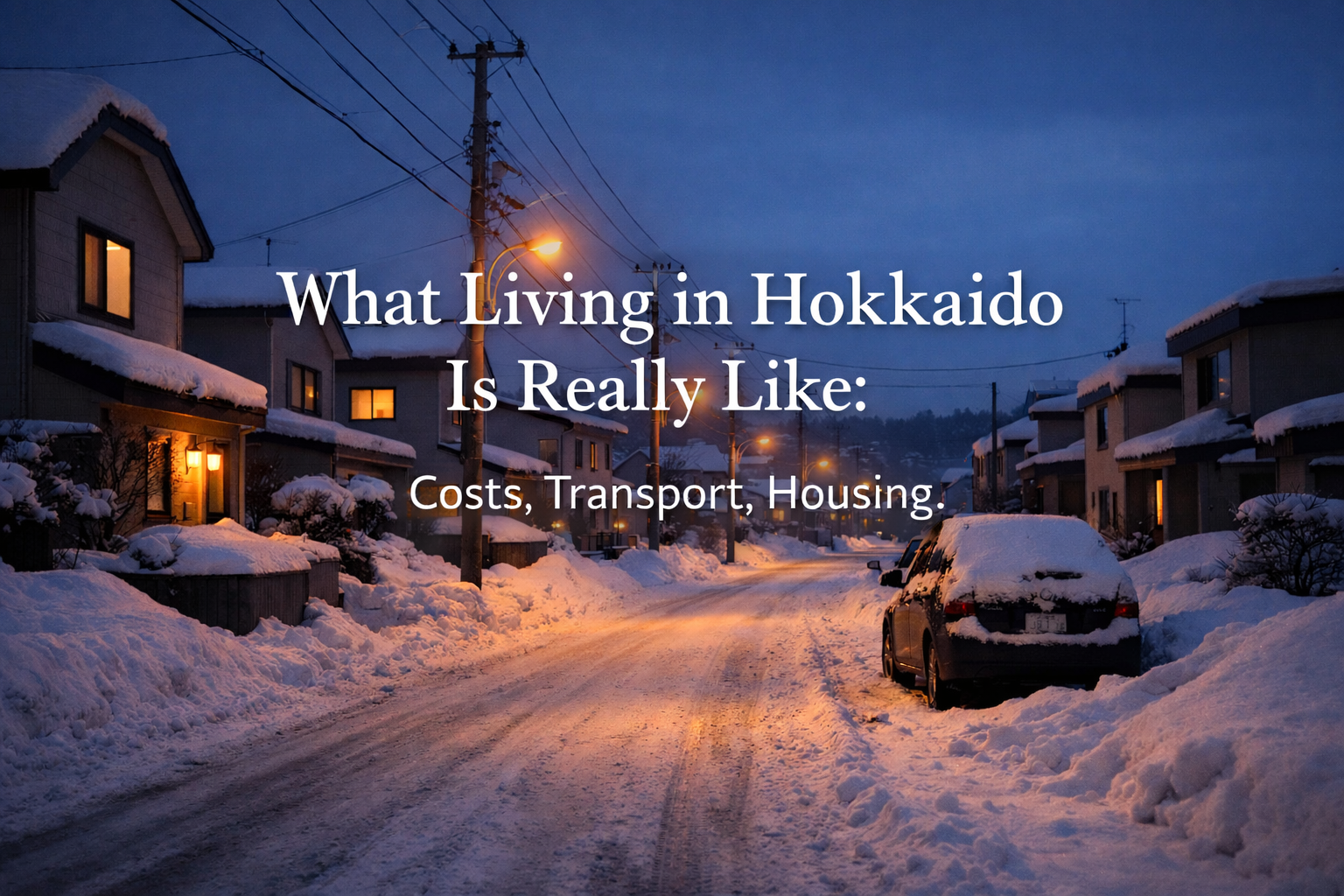
Life in Hokkaido is rarely dramatic.
There are no constant events, no sense of urgency in the streets,
and few situations that demand immediate reaction.
Instead, life settles into patterns.
Grocery shopping happens on fixed days.
Snow removal happens before work.
Driving replaces walking almost without notice.
Over time, these repetitions stop feeling restrictive.
They begin to feel dependable.
Many newcomers expect nature to dominate daily life.
What actually dominates is routine.
For some people, this predictability feels limiting.
For others, it provides stability rarely found in faster cities.
Transportation Shapes Everything
In most parts of Hokkaido, daily life assumes access to a car.
This is not a lifestyle choice.
It is a practical response to distance.
Towns are spread apart.
Facilities are centralized.
Walking is rarely efficient.
Public transportation exists, but it follows regional logic rather than urban convenience.
Missing one bus can mean waiting an hour.
In winter, weather overrides timetables entirely.
Snowfall, wind, and visibility often decide when movement is reasonable.
Real-time warnings and forecasts published by the
Japan Meteorological Agency
become part of daily decision-making.
Driving therefore becomes a life skill rather than a convenience.
Not because conditions are extreme,
but because planning matters more than speed.
Housing: Warmth Matters More Than Design
Housing in Hokkaido reveals its priorities quickly.
Appearance matters less than performance.
A stylish apartment means little if heat escapes through thin walls.
Winter comfort depends on practical elements:
- Insulation quality
- Window structure
- Heating systems
Many people learn this only after their first winter.
Cheap rent can quietly transform into high heating bills.
Warmth is not treated as luxury here.
It is treated as function.
Comfort is measured not by space or style,
but by whether you forget about the cold indoors.
Daily Costs Are Predictable, Not Cheap
Living expenses in Hokkaido tend to be stable.
Food prices fluctuate little.
Rent is often reasonable.
Services are consistent.
The major variable is energy.
Heating costs rise sharply during winter months.
This is rarely shocking,
but it requires mental adjustment.
Official guidance on winter living and household energy use is published by the
Hokkaido Government
,
reflecting how central heating management is to daily life.
The cold itself is manageable.
Paying to stay warm is the real calculation.
Convenience Is Lower — Stress Often Is Too
Convenience in Hokkaido is limited.
Stores close earlier.
Deliveries take longer.
Choices are fewer.
At first, this feels inconvenient.
Over time, it often feels relieving.
With fewer options comes less comparison.
Less urgency.
Less fear of missing out.
Life becomes simpler not through effort,
but through environment.
Social Life Changes Quietly
Social interaction slows naturally.
Especially in winter.
People stay home more.
Plans require intention.
Spontaneity decreases.
Relationships tend to deepen or fade on their own.
There is little space for constant surface-level connection.
For some, this feels isolating.
For others, it feels honest.
Who Often Struggles Living in Hokkaido
Life here does not suit everyone.
- Those who depend on constant stimulation
- People uncomfortable with long winters
- Anyone who dislikes planning ahead
- Those who feel anxious in quiet environments
Many of these concerns connect directly to issues discussed in
our safety and reality guide for Hokkaido
.
Hokkaido does not adjust quickly.
People adjust to it.
Who Often Feels Comfortable Here
Others find the environment unexpectedly supportive.
- People who value quiet time
- Those comfortable being alone
- Anyone seeking stable routines
- Individuals who prefer space over speed
Comfort here comes from alignment,
not endurance.
An Honest Summary
Living in Hokkaido is not difficult.
It is selective.
It rewards preparation over spontaneity.
It values calm more than convenience.
And for people whose lives improve with fewer demands,
Hokkaido often feels not restrictive —
but sustainable.
コメント